

Many companies still use SMS as a channel for single campaigns and sales. The most successful companies work differently. They use SMS strategically throughout the entire customer journey – from initial sign-up to repurchase.
It is not necessarily about sending more messages. It is about sending the right messages at the right times. When SMS is used relevantly and thoughtfully, the channel can help drive sales, engagement, and stronger customer relationships.
In this article, we look at seven concrete SMS marketing use cases to inspire you – whether you are just getting started with SMS or are already actively working with the channel.
7 SMS marketing use cases
There is no single right way to work with SMS marketing.
Some companies use SMS to drive quick sales through campaigns and limited-time offers. Others focus on automated flows that strengthen the customer experience and generate more repeat purchases over time.
What the most successful companies have in common is that they use SMS at the times when the message creates the most value for the individual recipient.
Below are seven concrete SMS marketing use cases that some of the most successful companies use to drive sales, loyalty, and stronger customer relationships.
1. Welcome flow
The welcome flow is often the first place companies start with SMS marketing.
When a customer signs up for your newsletter or SMS list, their interest is typically at its peak. The customer has just chosen to hear more from you, making the likelihood of engagement high.
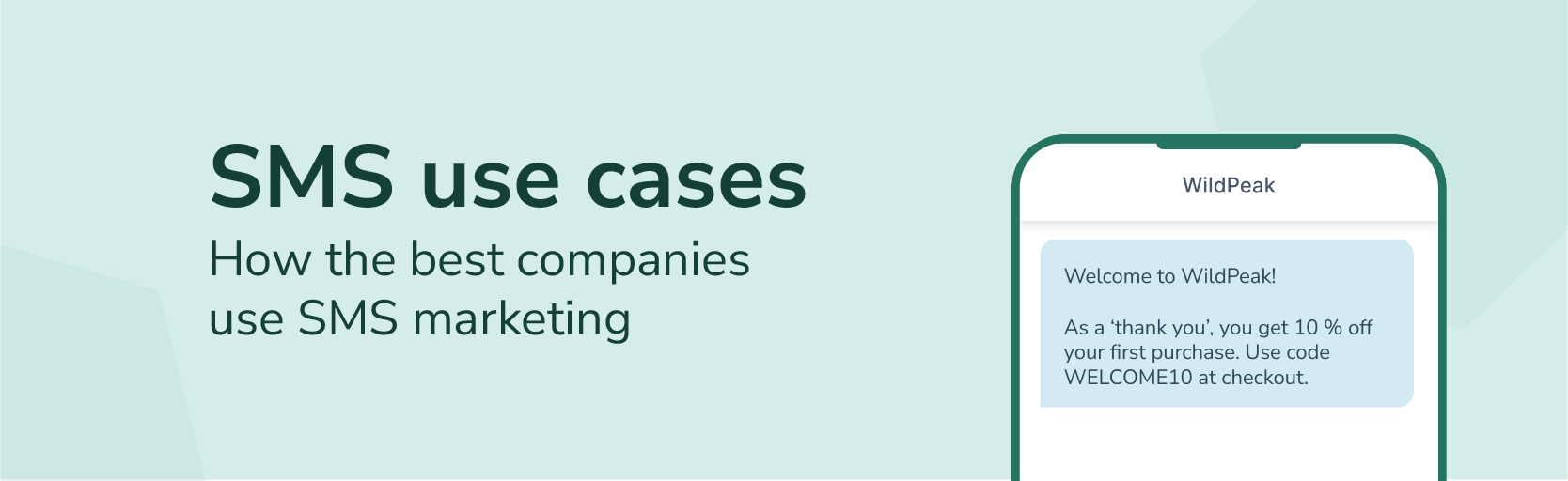
The best companies do not just use the welcome message to say "thank you for subscribing". They use it to set expectations, introduce their brand, and give the customer a good reason to make their first purchase.
A welcome flow can, for example, include a welcome discount, information about membership benefits, or inspiration for popular products. The goal is to create a positive first experience and get the relationship off to a great start.
2. Abandoned cart SMS
Most webshops experience that a large portion of customers abandon their cart before completing the purchase.
Some get interrupted. Others want to compare prices or think about the purchase. And some simply forget that they had items in their cart.
Here, an abandoned cart SMS can be the difference between a lost sale and a completed order.
Instead of letting potential customers disappear, the company automatically sends a reminder shortly after the cart has been abandoned. The customer has already shown great interest by adding items to the cart. Therefore, a simple reminder is often enough to bring the customer back to complete the purchase.
That is exactly why abandoned cart SMS is one of the most popular SMS automations among e-commerce companies.
The most skilled companies keep the message short and relevant. The purpose is not to pressure the customer into buying, but to make it easy to return and complete the order.
3. VIP access
The best customers are those who buy the most, return, and recommend your business to others.
That is why many companies use SMS to give their most loyal customers access to something special. This could be early access to sales, new collections, product launches, or exclusive offers not shared with everyone else.
SMS is particularly well-suited for this type of communication because the message feels more personal than many other marketing channels. When customers get access to something special before everyone else, it also makes them feel more valued.
This not only strengthens the relationship with the customers. It can also help drive increased engagement and sales among those who have already shown the greatest interest in your brand.
4. Flash sales and limited-time offers
Flash sales work best when the message is simple, the offer is strong, and the recipient can quickly understand why it is relevant right now.
Here, SMS is an obvious channel because it is well-suited for short, time-sensitive messages. When an offer is only valid for a few hours or, for example, until midnight, it is crucial that the message is seen in time.
The most skilled companies do not use flash sales all the time. If everything is urgent, nothing is urgent. Therefore, limited-time offers work best when used thoughtfully and only sent to customers for whom the offer is relevant.
This way, SMS can help drive quick action without customers experiencing the communication as noise.
5. Back-in-stock messages
Some customers are ready to buy immediately. Others wait for the right product to come back in stock.
That is why back-in-stock messages have become a popular SMS use case among many e-commerce companies.
When a customer actively signs up for a 'back in stock' notification, they have already shown interest in the product. This makes SMS an obvious channel when the item becomes available again.
Beskeden bør sendes, så snart produktet er tilbage på lager. På den måde får kunden mulighed for at handle hurtigt, mens interessen stadig er høj – og inden varen risikerer at blive udsolgt igen.
At the same time, the customer experiences it as a service rather than an advertisement because the message delivers information the customer specifically requested.
6. Win-back messages
It usually costs more to acquire new customers than to get previous customers to buy again.
Yet, many companies focus the majority of their marketing efforts on new customers, while existing customers gradually become less active.
Here, win-back messages can be an effective way to reactivate customers. And it can even be done completely automatically with the right SMS flow.
Typically, the message is sent to customers who have not made a purchase within a selected period. The purpose is to remind them of your business and give them a good reason to return.
Some use a special offer. Others highlight new products or popular favorites. The most important thing is that the message feels relevant to the recipient.
The best companies do not see win-back campaigns as a last-ditch effort to save the customer. They see them as a natural part of building long-term customer relationships.
7. Loyalty and benefits
SMS is not just about driving the next sale. Companies that know how to use the channel strategically also manage to strengthen the relationship with their existing customers using SMS.
This can be through loyalty programs, membership benefits, special invitations, or small rewards along the customer journey.
When customers feel valued, they are often more likely to buy again and recommend the company to others. Therefore, many companies use SMS to communicate the benefits that come with being a loyal customer.
At the same time, SMS is an obvious channel for this type of communication because the messages are perceived as more direct and personal than many other marketing channels.
Ultimately, loyalty is not just about discounts and points. It is about creating a relationship that customers want to be a part of.
What characterises the most successful SMS marketing strategies?
Although companies that actively work with SMS do so in many different ways, there are some common traits often found among those who get the most value out of the channel.
Read also: RCS for e-commerce: How webshops can use RCS to increase engagement and sales
1. They use SMS for the most important messages
SMS does not have to be the channel for everything.
On the contrary, many companies achieve the best results when they use SMS at times when the message is particularly important or time-sensitive. This could be an abandoned cart SMS, a limited-time offer, or a message that a popular product is back in stock.
2. They ensure relevance
The best results do not always come from sending the same message to everyone.
Successful companies use customer data, segmentation, and automation to send messages that match the individual customer’s interests and behavior. The more relevant the message is, the greater the likelihood that the customer will perceive it as valuable.
3 They think long-term
The most successful companies do not just focus on the next click or the next order.
They work purposefully to build a channel that customers want to stay on. This means they send fewer, but more relevant messages, constantly focusing on creating value for the recipient.
In short: The companies we see getting the most out of the SMS channel do not necessarily send more SMS messages. They send better SMS messages.
Read also: How to create a sharp strategy for SMS marketing
Which SMS use case should you start with?
If you are new to SMS marketing, it can be tempting to try everything at once. But it often yields better results to start with one or two use cases and build from there.
As a rule of thumb, you can consider:
- Welcome flows, if you want to convert new subscribers into customers.
- Abandoned cart SMS, if you want to extract more orders from your existing traffic.
- Back-in-stock messages, if you often have sold-out or pre-order products.
- Win-back messages, if you have many previous customers who have not bought anything for a long time.
- Loyalty programs, if you want to strengthen the relationship with your most engaged customers.
The best SMS strategy depends on your business, your customers, and your goals. But common to all use cases is that they work best when they create real value for the recipient.
This is also why the most successful businesses don’t just view SMS as another marketing channel. They see SMS as one of the most direct and personal ways to communicate with their customers.
