

We have compiled 10 basic rules for an effective SMS campaign that will keep both you and your customers happy - if the channel is used correctly.
1. Always send sharp, compelling offers
Customers go for the best deals. Always ensure the SMS you send contains an offer your customers can’t miss. Before finalising an offer, ask yourself if it will drive customers to visit your store, complete checkout, book an appointment, and so on.
When consumers are asked which messages they respond to the most, they answer the following:
- Price-sensitive offers
- Time-limited offers
- Product-specific offers
We therefore recommend using your limited time with customers to promote messages within one of these three categories to maximise the impact of your SMS marketing.
2. Start your SMS message with the offer
SMS marketing messages are designed to be sharp and to the point. Your customers are busy, so if your message doesn’t grab their attention immediately, you’ll be forgotten just as fast.
By placing your offer at the start of the SMS, you maximise attention. Keeping your text sharp and to the point ensures your message doesn’t get lost in irrelevant content.
3. Make it exclusive
To get the most from your SMS campaign, make the offer feel exclusive to each recipient. Make them feel they’ve received a special opportunity just for them. If the offer applies to everyone, it becomes less urgent and less appealing. Successful SMS sales rely on making recipients feel unique and valued by your business.
Make every SMS worth reading. Your customers give you approval to send them messages in return for the expectation of receiving value from your business. Make sure not to send them vague offers every week, but instead utilise each SMS message to pass on something valuable to the recipient. This can be anything from unique discount codes, important news, special events - all of which is useful information to share with your customers.
Worth remembering:
- Make sure customers don’t see the same offer in a Facebook ad or another SMS a few weeks later.
- Unique discount codes work better when made up of random characters. For example, avoid sending “BLACK18” and instead use “QX18TYU”.
- Including the recipient’s first name shows your business’s personal touch and exclusivity.
4. Create urgency
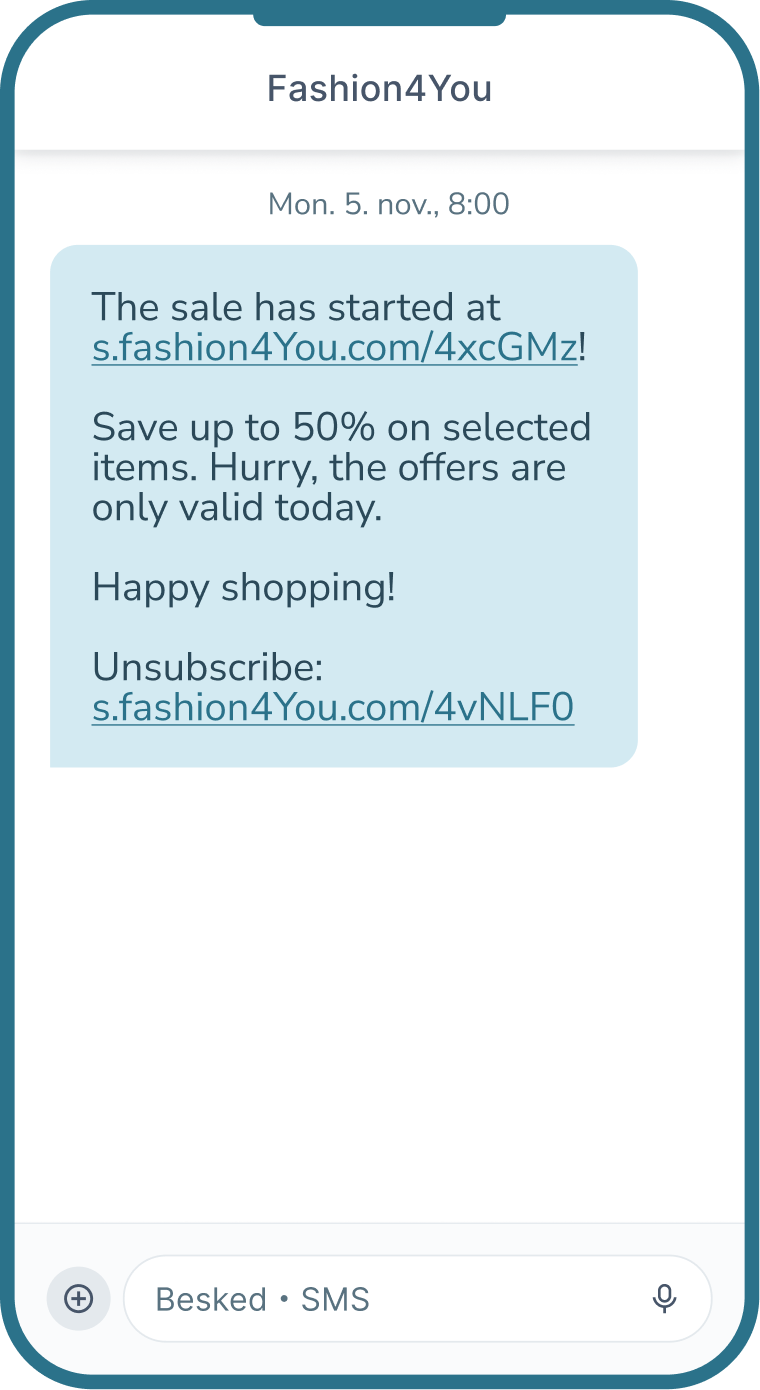
By setting a time limit on your offer, you increase the chances of getting a response. Customers will prioritise your business if you give them a clear reason. An offer is relevant when it has an expiry date or limited quantity, and this is clearly communicated.
Sending SMS offers too frequently risks diluting their urgency. We recommend sending 2-4 offers per month. More than that may weaken your offers and annoy your SMS recipients.
5. Location, location, location
One of the most important parts of your SMS is clearly stating where customers can redeem the offer. Always specify where the offer applies—even if you run a webshop. Customers quickly lose patience if you grab their attention without telling them where to redeem the offer.
Remember:
- IInclude the campaign link in your SMS. It looks unprofessional and sloppy to send a follow-up SMS saying, “Sorry, we forgot the link…”
- Be careful with your links. Keeping them short, simple, and credible will increase click-through rates.
- Avoid URL shorteners like Bit.ly. Customers feel more secure clicking links that clearly show your business as the sender.
6. Remember a call to action
A call to action (CTA) is crucial to guide your customers through the sales funnel. Keep your CTA short, simple, and easy to follow. Assume your customers are initially uninterested and your CTA must motivate them to take action.
Here's how you do it:
- Use rhetorical triggers that boost conversion rates; words like access, secret, limited time, exclusive, premium, and so on.
- Make sure to communicate clearly rather than cleverly. When writing your CTA, it’s tempting to craft a witty or cheeky phrase to prompt a response. But it’s better to keep your CTA text clear and straightforward.
- Be specific about what your offer entails. For example, if you’re running a promotion with 50% off your entire shop, write something concrete like “Click to get 50% off the entire shop! Valid today only.” rather than something vague like “Get 50% off today.”
7. Make your brand name clear
Make yourself clearly known. Nobody likes receiving anonymous messages. There are several ways to make your brand clear to recipients of your SMS messages.
The sender ID can serve this purpose, but what your recipients actually read when opening the message is the message content itself. Therefore, it’s a good idea to end your SMS message by clearly stating who the sender is.
When you send SMS messages via inMobile, you can choose your own sender ID. For example, we send as “inMobile” so recipients can easily recognize us as the sender. This builds credibility and prevents your business from being perceived as spam.
8. Send your SMS message at the right time
When should you send your SMS messages? Not too early, and not too late.

Marketing messages are generally best received between 8 AM and 9 PM, not earlier or later. It’s important to note this refers to your recipients’ time zones, not your business’s. So if you send SMS messages across different countries, be sure to consider the various time zones your customers are in.
Now that we know the best time window to send SMS messages, let’s discuss when exactly to send them. Did you know that 90% of all SMS messages are read within 3 minutes of arriving on the recipient’s phone? Since SMS messages are opened so quickly, it’s best not to send your offers too far in advance. There shouldn’t be too much time between when your SMS is received and when the offer is valid.
9. Avoid unsubscribes
Weekend vs. weekday…? Unsubscribe rates for SMS offers sent on weekends tend to be higher than those sent on weekdays. However, there’s no golden rule for whether it’s best to send SMS messages on weekends or weekdays.
That’s why it’s best to analyze when your business experiences the most unsubscribes. Review your data to understand when your customers prefer to hear from you. Check if it’s specific days, times during the week, or weekends. This insight is invaluable for maintaining a strong SMS customer club and maximizing your SMS marketing results.
You can also consider supplementing SMS with a transactional email from time to time so that not all communication is sent via SMS.
10. Track your SMS campaign
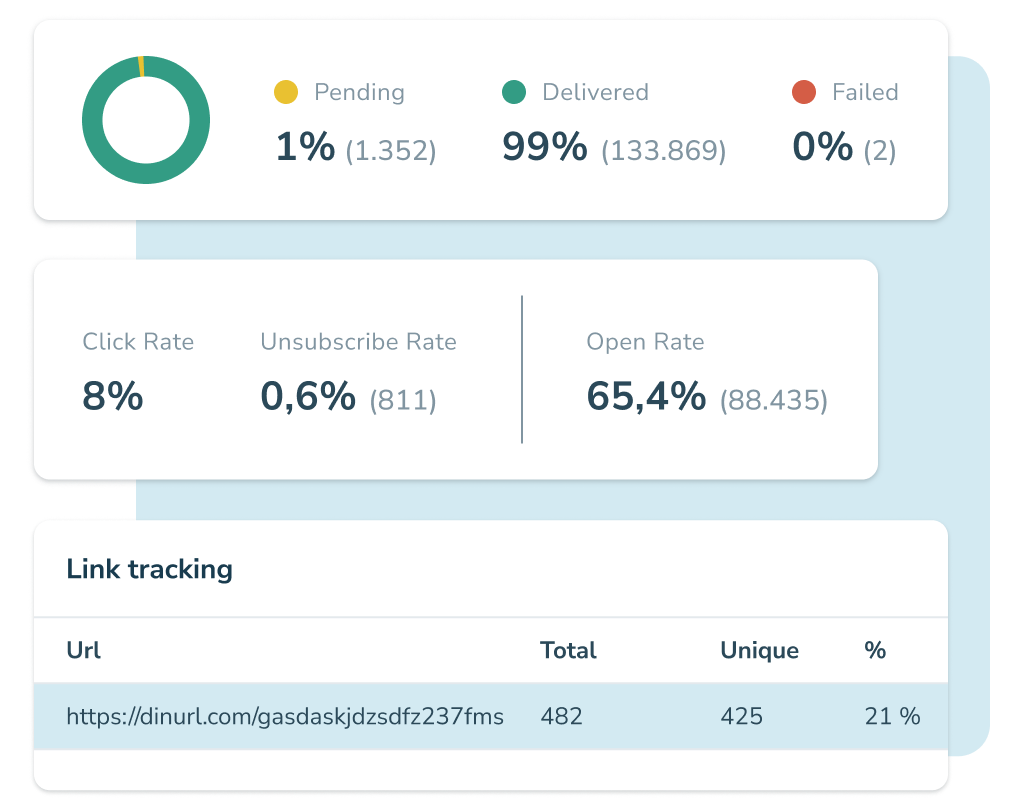
The value of using the right links is often underestimated. To accurately measure clicks, performance, and impact, you need a reliable SMS gateway that handles links and tracking seamlessly.
Besides sparing your recipients from having to search for your news, offers, and stories, a link is also a powerful tool to track the popularity of each SMS message by measuring how many click through to a specific story or offer via the SMS.
This is done by creating your link with a built-in analytics tool that quickly provides an overview of how often the link is clicked. The tool calculates how many people visit your website via the link in the SMS message, giving you insight into how well your SMS marketing is performing.
With a UTM tag in your link, you can identify traffic coming from a specific SMS message within a particular campaign. This lets you see how much your SMS message has contributed to the overall campaign results.
If you own a webshop, it’s important to set up e-commerce tracking in your Google Analytics account. This tracking lets you see how much revenue you’ve generated – highly relevant data.
Using a discount code in your SMS campaign allows you to track how many have redeemed it and thus how well your SMS message performed. The discount code should be unique to each specific campaign. Reusing the same code across campaigns makes it difficult to track individual campaign performance.
Note. If you want to work even more data-driven and visually, take a look at RCS. With RCS marketing you get new and many more opportunities for both engagement and tracking.
