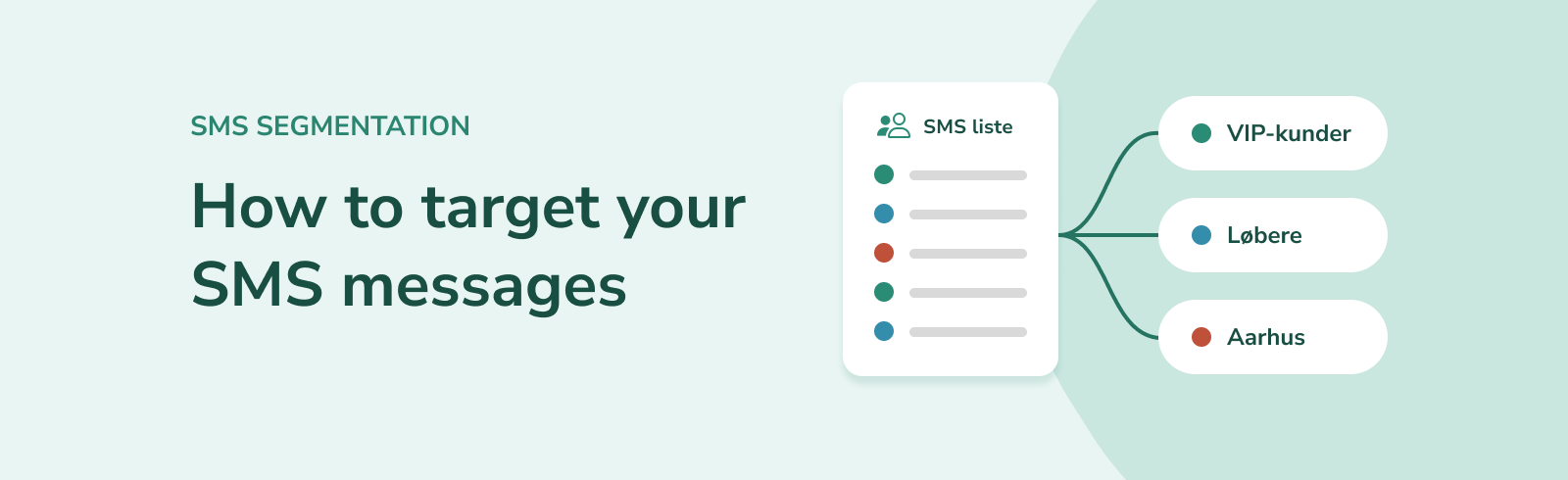


SMS segmentation – the right message to the right customers
SMS is a direct channel to your customers. That is why it is worth considering who should receive which messages.
Because even though some campaigns are relevant to your entire SMS list, not every customer needs to be notified every time you launch a new product, hold a sale, or invite people to an event.
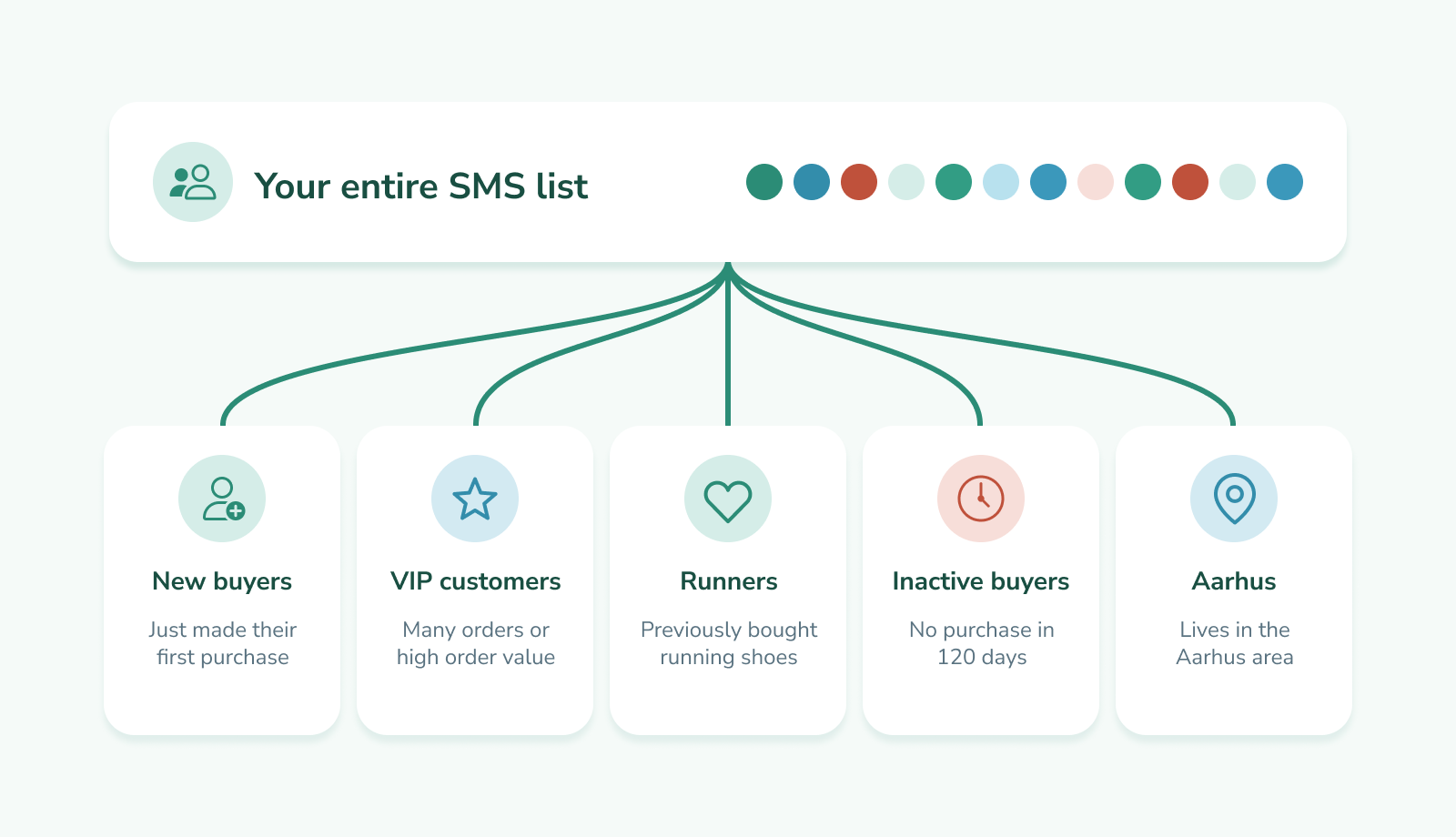
With SMS segmentation, you can divide your recipients into smaller groups and target your messages based on, for example, purchase history, interests, behaviour, or geography.
It does not have to be complicated. If you have access to a few relevant customer data points, you can go a long way with simple segments.
In this article, you will get concrete examples, practical advice, and help to get started with SMS segmentation.
What is SMS segmentation?
SMS segmentation is about splitting your SMS recipients into smaller groups – for example, based on purchase history, interests or location. That way, you can target your messages at the customers they are relevant to.
Imagine that you run an online store that sells both men's and women's clothing. You are launching a new collection of men's clothing and want to tell your customers about it.
You could send the news to your entire SMS list. But if you have data on which customers have previously purchased men's clothing, you can also choose to send the campaign to that specific group.
The same applies if you want to invite customers to an event at your Aarhus store. In this case, it will often be more relevant to contact customers in Aarhus and the surrounding area than to send the invitation to all your recipients in Denmark.
A segment can therefore be broad or very specific. The crucial thing is that the division helps you send a relevant message to the right target audience.
Why segment your SMS recipients?
SMS is a direct form of communication, and therefore it is important that your messages are relevant to those who receive them.
A customer who has just bought a pair of running shoes might be interested in new running gear. Another customer who exclusively buys hiking gear might not have the same interest.
With segmentation, you can account for that difference.
It allows you, among other things, to:
- Send more relevant messages: Recipients get messages that better match their interests.
- Make the most of your customer data: Get more value out of the knowledge you already have.
- Tailor communication to the customer journey. A first-time buyer often needs something different than a loyal customer who has been shopping with you for years.
- Learn more about your target audiences. When you track results for different segments, you gain a better foundation for planning future campaigns.
- Use your SMS budget more effectively: You avoid sending unnecessary messages to your entire list.
This doesn't mean you always have to segment.
For example, if you are having a big sale that is relevant to the majority of your customers, a broad SMS campaign may well be the right choice.
The most important question, therefore, is not how many segments you can create, but:
Who is this message relevant to?
What data can you use for SMS segmentation?
You don't need to know everything about your customers to segment them. But you must have access to the information you want to use as criteria.
For an e-commerce business, data will typically come from the webshop, the CRM system, the marketing platform, or information the customers have provided themselves.
Here are four relevant starting points.
1. Purchase history
Purchase history is an obvious place to start because it tells you which products your customers have bought in the past.
For example, you can segment by:
- Products or product categories the customer has purchased
- Number of previous purchases
- Total order value
Example: New running shoes
You run an online store selling running gear and shoes and have just received a new collection.
Instead of automatically sending the news to all your SMS recipients, you can create a segment of customers who have previously purchased running shoes.
An SMS to this segment could look like this:
Previous purchases are, of course, no guarantee that a customer will be interested again. However, it gives you a more concrete basis for selecting recipients than sending to your entire list.
2. Interests
Customers don't have to have bought a product to have shown an interest in it.
If you have access to information about which products or categories your customers are interested in, you can use it to target your SMS campaigns.
This could, for example, be:
- Customers interested in gaming gear
- Customers who have shown an interest in skincare
- Customers who have visited specific product categories
A beauty webshop could, for example, target a new skincare line at customers who have previously shown an interest in similar products.
3. Geography
Geographic segmentation is particularly relevant if you have physical stores, local events, or offers that only apply to specific areas.
You can, for example, use postcodes or cities to narrow down your target audience.
Example: Customer evening in Aarhus
You have stores in several locations across the country and are hosting a customer evening in Aarhus.
Instead of inviting your entire SMS list, you can target the invitation to customers in Aarhus and the surrounding area.
An SMS message could read:
With inMobile, you can, among other things, segment by postcode and postcode range.
4. Customer activity and engagement
You can also use information about customer activity for your segmentation. This could, for example, be:
- When the customer last made a purchase
- How often the customer shops
- How many purchases the customer has completed
- Whether the customer clicks on links in your SMS campaigns
This information can help you assess how active your customers are and tailor your communication accordingly.
However, be aware that a lack of clicks does not necessarily mean a lack of interest. A customer may well have read your SMS without clicking the link.
7 SMS segments you can start with
There is no single list of segments that fits every company. The best segments depend on your business, your customers, and the data you have access to.
If you work in e-commerce, these seven segments are great places to find inspiration.
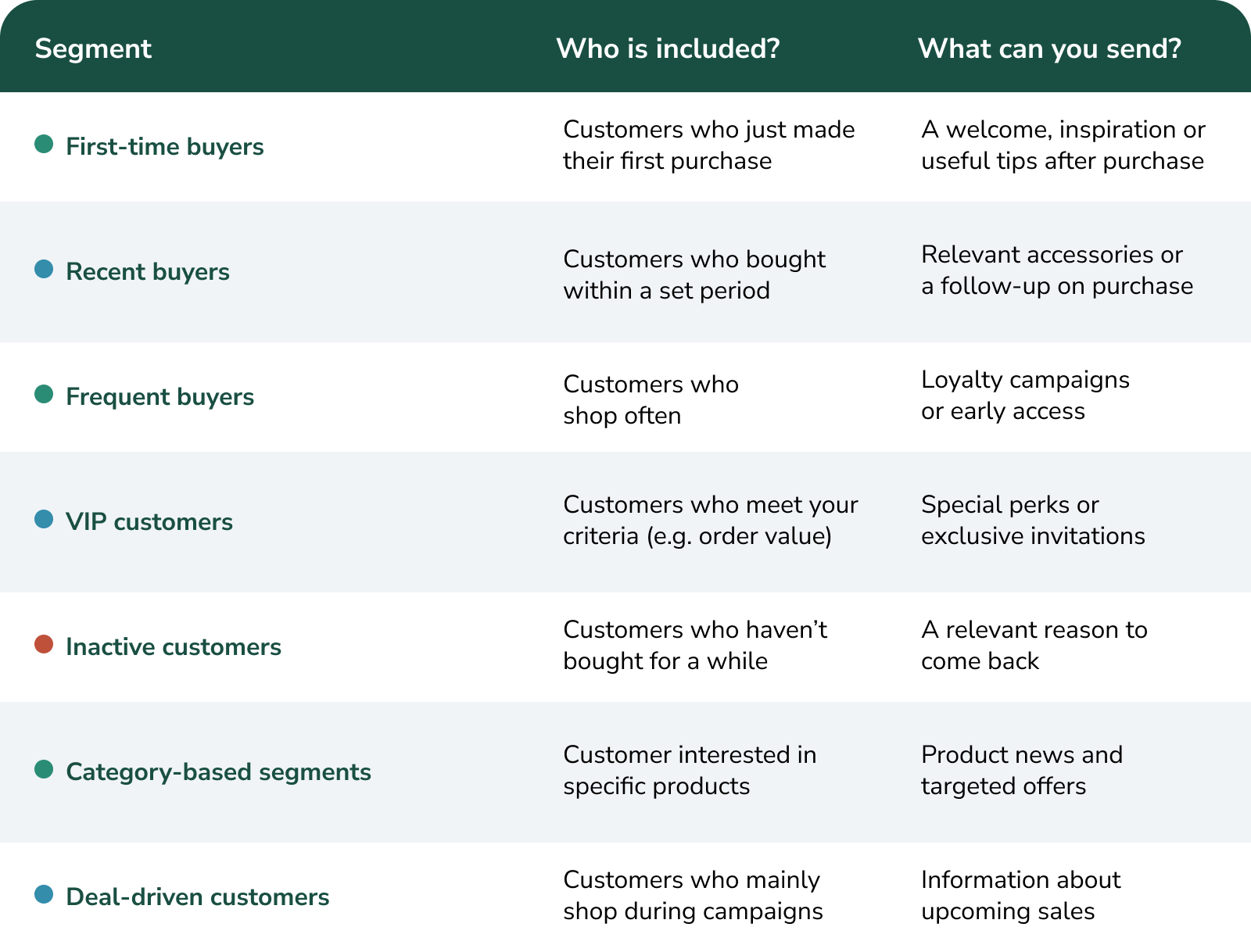
You don't need to create all seven. Choose the segments that make sense for your business.
Example: Reactivating inactive customers
Imagine that you sell products that customers typically buy several times a year.
You can create a segment of customers who have previously shopped with you but haven't bought anything in, for example, 120 days.
You can try to reactivate them with a targeted campaign:
How much time should pass before a customer is considered inactive depends on your products and the customers' purchasing patterns.
If you sell groceries, for example, 120 days might be a long time. If you sell furniture, it may be perfectly normal for customers not to shop for several months.
That is precisely why segments should be based on your business rather than fixed standards.
Use segmentation throughout the entire customer journey
SMS segmentation is not only relevant when sending offers and product news. You can also use segments to tailor communication to different stages of the customer journey.
For example, a first-time buyer might appreciate inspiration after their first purchase, while a loyal customer could be given early access to a campaign.
It is also worth considering who should not receive a specific campaign. For instance, if a customer has just bought a product at full price, it may be inappropriate to send a discount campaign for the same product the next day.
With segmentation, you can both select relevant recipients and exclude customers for whom the campaign is not suitable.
Read also: Get inspiration for your SMS marketing with concrete use cases
Use your customer data for SMS segmentation
With inMobile, you can segment your SMS recipients based on the customer data you have available.
If you have recorded postcodes or other relevant contact information, for example, you can use them to create target groups.
If you want to segment by purchase history, order value, or behaviour from other systems, you can use an integration.
With the Shopify integration you can, for example, work with purchase data such as products, purchase dates, and order value.
If you use Klaviyo, you can sync lists and segments between Klaviyo and inMobile. This allows you to use target audiences you have already created for your SMS campaigns.
So, you don't necessarily have to start from scratch with your customer segmentation.
How many segments do you need?
More segments do not automatically equal better SMS marketing.
If you divide your customer base into many small groups without a clear purpose, you may end up spending more time maintaining the segments than creating relevant communication.
Therefore, it is a good idea to start with two or three segments that you know how you want to use. You can always build on them as you gain more experience.
A good question to ask before creating a new segment is:
Do we want to send this customer group a different message from the rest of our recipients?
If the answer is no, you probably don't need a separate segment.
How to get started with SMS segmentation
If you haven't worked with segmented SMS marketing before, we recommend starting with one specific campaign rather than trying to segment your entire customer base at once.
1. Choose a campaign with a clear target audience
Find an upcoming campaign that is particularly relevant to a specific group of customers. This could be a new product launch, a local event, or an offer for past customers.
2. Find the data that can identify the target audience
Examine what information you already have and what you can use to identify the target audience.
3. Create your segment
Use the selected criteria to narrow down your target audience. Verify that the segment contains the recipients you expect.
4. Write an SMS that fits the segment
Tailor the message to the segment. Make it clear why the message is relevant to the recipient and what the next step is.
5. Send the campaign and track the results
Track the results you have access to, such as clicks, purchases, and unsubscribes. Evaluate them in relation to the campaign's objective.
6. Use your insights for next time
Consider whether the segment reached the right target audience and if you need to adjust the criteria for the next campaign.
Want to see how to create segments in inMobile? Follow our guide to segmentation.
SMS segmentation should make your campaigns more relevant
You don't need an advanced data model or many different customer groups to get value from SMS segmentation.
Start with the customer data you already have and find a campaign where it makes sense to select a specific target audience.
Sometimes the right target audience will be your entire SMS list. Other times, it will be customers who have purchased a specific product category, your most loyal customers, or those who live near a physical store.
The key is that you use your knowledge of your customers to make a conscious choice about who should receive your message.
FAQ - SMS segmentation
SMS segmentation means dividing your SMS recipients into smaller groups based on specific criteria. This could, for example, be purchase history, interests, geography or activity. The aim is to send more relevant messages to different target audiences.
Start by selecting a campaign and defining who it is relevant to. Then find the customer data that can identify the target audience, and create a segment based on it. This could, for example, be customers from specific postcodes or customers who have previously purchased a particular product category.
Among other things, you can use purchase history, product interests, postcode, date of last purchase, number of orders and engagement. Your options depend on what data you have access to and what information can be used in your SMS platform.
Yes. If you already have relevant information about your contacts, you can use it for segmentation. However, if you want to work with purchase history from your webshop, for example, this may require an integration.
There is no fixed number that suits every business. Two or three segments with a clear purpose are often a good starting point. Only expand once you have a specific need.
No. Some messages are relevant to your entire SMS list. Segmentation makes particular sense when you have a campaign that is more relevant to a specific group of recipients.